

| TL;DR Trademarks are registered per class. Class 025 is clothing. A phrase registered elsewhere may be free here, and vice versa.Copyright attaches automatically when a work is fixed. Nobody has to register it for your use of it to infringe.Titles, names, short phrases and slogans are not protected by copyright, which is a narrower comfort than it sounds.Right of publicity is state law. There is no federal version, and coverage is uneven. Short version: three separate bodies of law govern what you can put on a shirt, they overlap imperfectly, and the checks take about ten minutes each once you know which database answers which question. |
A rejection notice reading “1 – Policy Violation” tells you almost nothing. The two useful codes are the specific ones: 1.1 is copyright, which points at the artwork, and 1.2 is trademark, which usually points at the text.
Knowing which one fired tells you where to look, and that is the whole first step of a response. The full pre-upload checklist is set out in this Amazon Merch design compliance checklist, which covers artwork, title, description, bullets and brand name as separate surfaces, because they are.
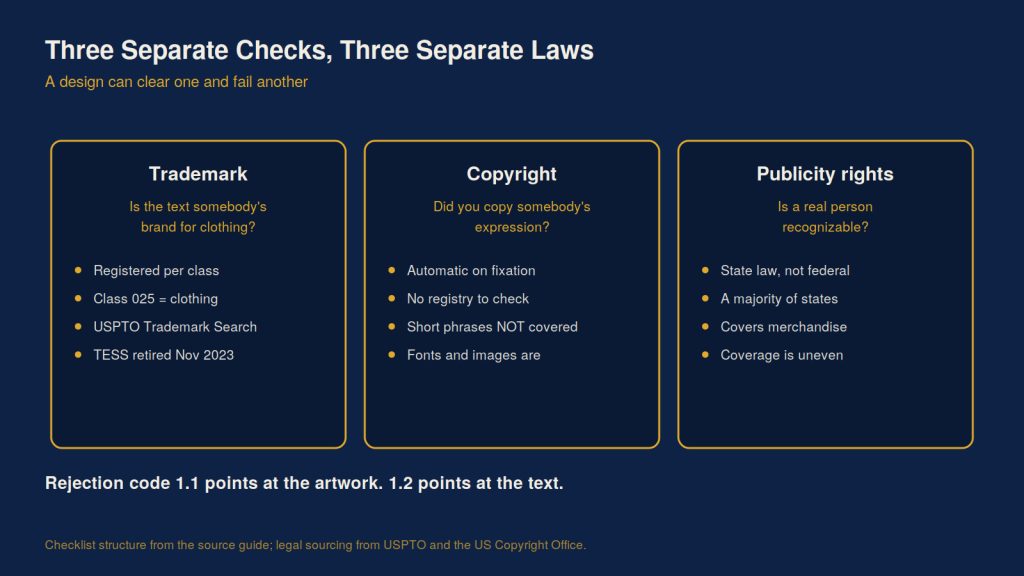
Three questions, three bodies of law. Clearing one says nothing about the other two.
Trademarks Are Registered Per Class, Not in General
This is the single most useful thing to understand about trademark searching, and it is why casual searches produce wrong answers in both directions.
A trademark is registered for specified goods and services, organized into international classes. Class 025 covers clothing. A phrase registered in Class 025 by someone else is the highest-risk phrase you can put on a shirt. The same phrase registered only in, say, a software or beverage class is a materially lower risk, though not a clear one.
Which means a search returning “this phrase is trademarked” is not an answer. It is the beginning of one, and the first follow-up question is always whether it is registered for clothing.
Two things stop the class boundary from being a wall, and both are worth knowing before you rely on it. Famous marks are protected against dilution across all goods regardless of class, so a household-name brand is off-limits whether or not it sells shirts. And infringement turns on likelihood of confusion, which courts assess across related goods rather than strictly inside the registered class. The class filter tells you where the concentrated risk is. It does not draw the edge of the right.
One correction worth making before you search. A great deal of published guidance, including some that is otherwise current, points sellers at the USPTO’s TESS system. TESS was retired on November 30, 2023. The current tool is the USPTO Trademark Search system, and searching it with a Class 025 filter is the check that matters. If a guide you are following still says TESS, it has not been updated since 2023, which is worth knowing about the rest of its advice too.
For international exposure, the WIPO global brand database covers registrations beyond the US, which matters if your listings are live in other marketplaces.
And a clean search is not a clearance. Trademark rights in the US can arise from use alone, without any federal registration, and unregistered common-law marks appear in no USPTO database. State registrations are also held separately. A phrase can return nothing in Class 025 and still belong to somebody who has been selling shirts with it for six years. The search rules out the worst outcomes cheaply. It does not certify the phrase.
Copyright Does Not Require Anyone to Do Anything
The second body of law works completely differently, and the difference catches people.
The US Copyright Office’s Circular 1 states it plainly: “Copyright protection in the United States exists automatically from the moment the original work of authorship is fixed.” Protection covers “original works of authorship” that are “fixed in a tangible form of expression,” where an original work “is independently created by a human author and possesses at least some minimal degree of creativity.”
The Copyright Office does keep a public catalog of registered works, but searching it clean proves nothing, because registration is not a condition of protection. An illustration someone posted in 2019 is protected whether or not it was ever registered. A font someone designed is protected as software even where the letterforms themselves may not be. The image you found through a search engine is protected unless something specific says otherwise.
Registration matters for enforcement rather than for existence. Circular 1 notes that although “registering a work is not mandatory,” for US works “registration (or refusal) is necessary to enforce the exclusive rights of copyright through litigation.” That is a fact about lawsuits, not a fact about whether you are infringing.
The Short-Phrase Exception, and Its Limits
Circular 1 also lists what copyright does not protect, and the list includes three things a t-shirt seller cares about: “titles, names, short phrases, and slogans”; “familiar symbols or designs”; and “mere variations of typographic ornamentation, lettering, or coloring.”
That sounds like an open door for slogan tees and it is narrower than it looks. A short phrase is outside copyright, which says precisely nothing about trademark. Text is the most common trigger for a trademark rejection on a Merch listing, and the reason is structural: a slogan that becomes commercially valuable is a slogan somebody registers in Class 025.
So the two checks are sequential and both are necessary. Copyright asks whether you copied someone’s expression. Trademark asks whether your text functions as somebody else’s brand for clothing. A phrase can clear the first and fail the second, and that combination is the most common rejection there is.
Publicity Rights Vary by State
The third area is the one where confident advice online is most often wrong.
There is no single federal right of publicity. The US Copyright Office’s 2024 report on digital replicas states that “no federal statute focuses solely on the use of an individual’s image, likeness, or voice,” while noting that “several serve to limit the creation or use of digital replicas in particular circumstances,” and that “a majority of states now recognize the right of publicity by statute, common law, or both.”
That qualifier matters and cuts against complacency. The absence of a dedicated federal statute does not mean no federal exposure. A shirt implying that a well-known person endorses it can support a false-endorsement claim under the Lanham Act, which is federal, entirely separate from whichever state’s publicity law applies.
Two details from that report bear directly on apparel. First, the protection is specifically commercial: “state right of publicity laws typically apply only where the infringement occurs in advertising, on merchandise, or for other commercial purposes.” A shirt is merchandise, which places it squarely inside the category these laws exist to cover.
Second, the report describes the landscape as “a patchwork of protections, with the availability of a remedy dependent on where the affected individual lives or where the unauthorized use occurred.” That cuts against the instinct to find one rule and apply it. There is no one rule.
The workable posture for a seller is simple and does not require a lawyer: do not put a real person’s name, face, or recognizable likeness on merchandise without permission, and treat athletes, musicians and public figures as the highest-risk category rather than the most commercially appealing one, even though they are both.
The Checklist, in the Order That Saves Time
Four checks, sequenced cheapest first.
Check the phrase. USPTO Trademark Search, filtered to Class 025, plus a plain web search for anyone already selling apparel under it. The second half is what catches unregistered rights. Ten minutes.
Check the images and fonts. Where did each element come from and what does its license actually permit for commercial use on merchandise. Keep the license file.
Check for real people. Names, faces, likenesses, teams, and anything that functions as a reference to a specific person.
Check the metadata separately. Compliance is not only the artwork. Title, bullets, description and brand name are all surfaces where a protected term can appear, and a clean design with a trademarked word in the bullets is still a rejection.
Keep the Paperwork
The last habit is the one that pays off only once, and pays off completely.
For every design, keep the license or proof of rights for each element you did not create yourself, filed where you can find it. When a listing is challenged, the difference between a fast reinstatement and a permanent loss is usually whether you can produce that evidence within a day.
Nobody wants to run a filing system for t-shirts. It is still cheaper than rebuilding a catalog.